

Foto: Heike Blenck
Nina George
Writer and Honorary President of the European Writers' Council (EWC).


The free internet is being destroyed – it has been taken over by the big tech monopolies. The growing dominance of the platform giants in the fields of information and communication is leading to a concentration of influence over public opinion that threatens our democracy.
But the internet belongs to us all; we must liberate it from the dominance of these monopolies: our society needs social networking, communication and debate platforms other than those run by Chinese and US monopolies.
Writer and Honorary President of the European Writers' Council (EWC).

Writer, director, musician, artist

Regional Director of ver.di Hamburg and Deputy Chair of the NDR Broadcasting Council

Author and media studies scholar

German Journalists’ Association (DJV)

Author

Tech blogger

Managing Director, Bonn.digital

Science communicator and public relations officer, University of Innsbruck

Visiting Professor Of Law, College of Europe

Co-founder of Save Social
Wir fordern: Die Bundesregierung soll X sofort verlassen und auf offene, gemeinwohlorientierte Plattformen wechseln.

Through the Newsmast Foundation, Save Social aims to establish the ‘European Social Stack’ as a decentralised infrastructure based on open protocols in Europe.
Digital Independence Day (DI.DAY) is an international movement campaigning for greater digital sovereignty. Let’s switch together, every first Sunday of the month.

Communications professionals from the worlds of business, culture, the media and public administration demonstrate how they successfully use open networks without Big Tech.
263.000+
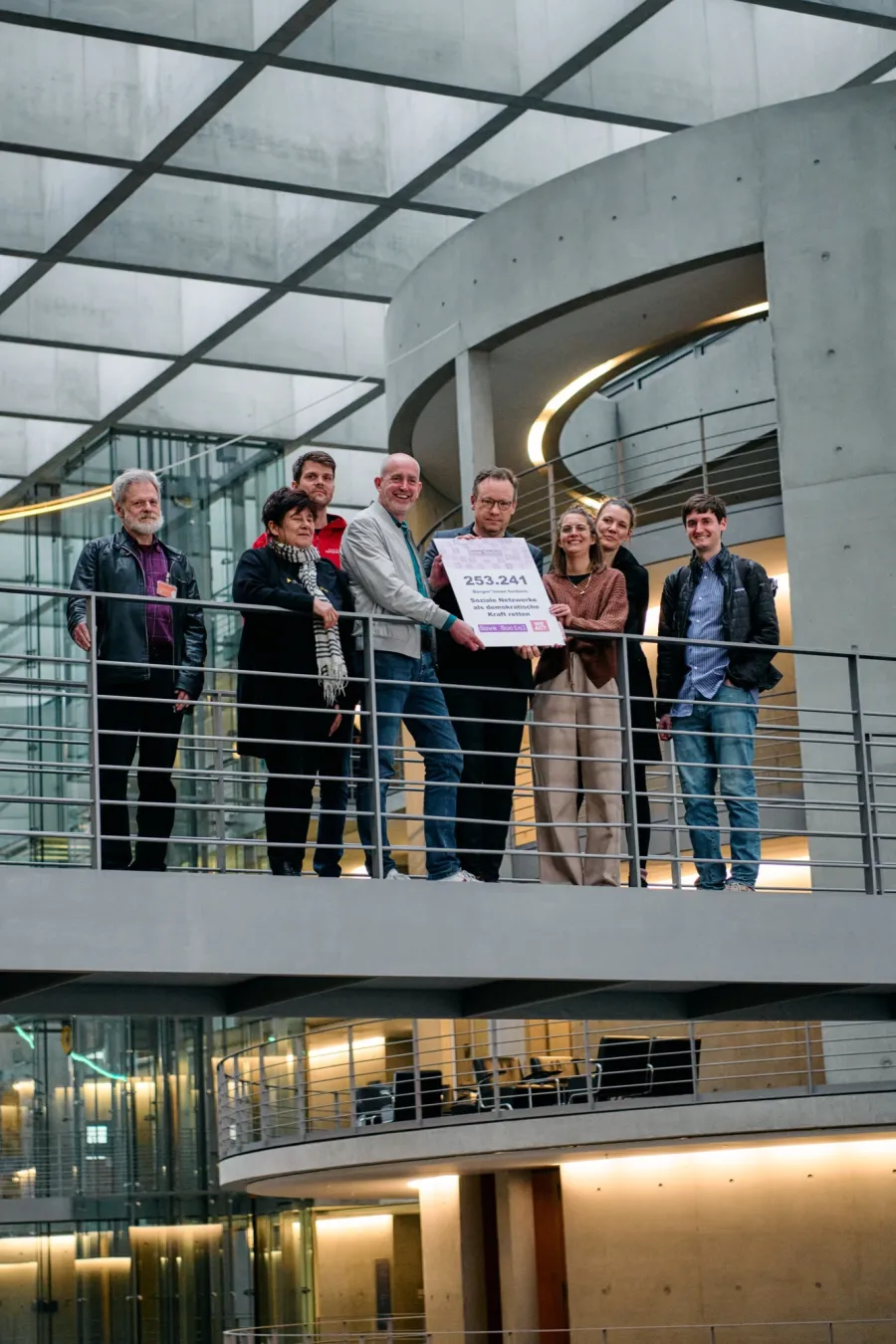
supported our petition „Save Social“
300+
people attended our conference 2MR
700+
organisations and people support our initiative European.Social
20+
charities joined our Mastodon server stiftungen.social (external link)
100.000+
people visit the DI.DAY website every month
169.000+
supported our petition „Keine Macht für Oligarchen“ (external link)

Schon mal in der Küche mit fettigen Fingern versucht, durch das Rezept auf dem Handy zu scrollen? Das wird nichts.
Wir unterstützen Euch dabei, Eure Community wieder selbst zu organisieren. Auf einer Plattform, die Euch gehört und deren Regeln Ihr selbst bestimmt.

Mit dem Grimme Online Award zeichnet das Grimme-Institut seit dem Jahr 2001 „hochwertige publizistische Online-Angebote“ aus.

Unter dem Dach von European.Social hat sich eine breite europäische Bewegung formiert, die eine eigenständige, dezentrale und offene soziale …
We are a not-for-profit organisation (gemeinnützige Unternehmergesellschaft, gUG) that was founded in the summer of 2025 with the support of a broad network of people and organisations. Our aim is to safeguard the democratic power of social media. The work of Save Social was initiated by a petition which gathered more than a quarter of a million signatures in the spring of 2026. Today, building on the text of this petition, the initiative coordinates this broad network and drives initiatives against Big Tech and in favour of open social networks that strengthen democracy. More about that on Who we are
Our work rests on three pillars: Firstly, we aim to persuade as many organisations, individuals and communities as possible to switch to better social networks. Secondly, to ensure these networks reach a wide audience, we are working to improve the framework for open platforms in Europe: for example, the operation of platforms serving the public good should urgently be recognised as a charitable activity. And additional funding is needed to make open platforms a credible alternative to the major Big Tech monopolies from the US and China. Thirdly, we engage with many politicians and decision-makers at state, federal and European level to advance our goals through lobbying.
Save Social is committed to preserving democracy – a goal that should unite all democrats from left to right. We therefore see ourselves as non-partisan and independent of the political objectives of individual parties.
We are funded exclusively by donations, both large and small. The many small donations we receive from our supporters are particularly important to us. In addition, since 2026 we have also been supported by the Rossmann chemists’ chain and the search engine Ecosia – a commitment by two European commercial enterprises to champion digital sovereignty.

